

Ofev Reduces Annual FVC Decline by 93 ml Compared to Placebo
The government recently highlighted interstitial lung disease (PF-ILD) as a condition needing enhanced insurance coverage. Following this, a public petition has emerged requesting insurance coverage for 'Ofev (ingredient nintedanib),' drawing attention to whether this long-unlisted drug will finally be covered.
PF-ILD is characterized by inflammation in the walls connecting the alveoli, known as the interstitium. Recurrent inflammation can lead to fibrosis, causing the lungs to harden and making oxygen supply difficult.
A common type of PF-ILD is idiopathic pulmonary fibrosis (IPF), with symptoms including shortness of breath, dry cough, chest discomfort, and fatigue. Without proper treatment, respiratory failure can occur, potentially leading to death.
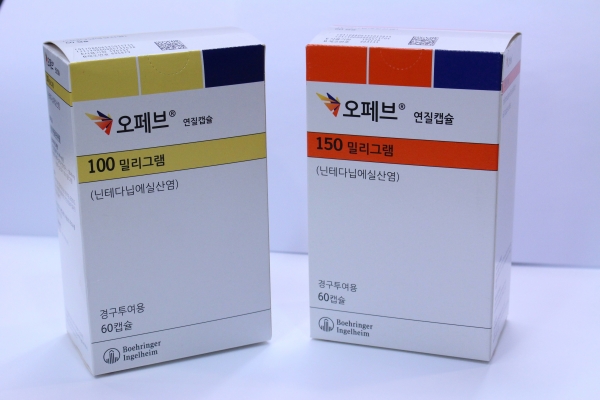
Ofev, a treatment for IPF, works by blocking key signaling pathways involved in the proliferation, migration, and transformation of fibroblasts, which are essential to IPF progression. It was approved by the Ministry of Food and Drug Safety (MFDS) in 2016 as a treatment for IPF.
In 2020, its indications were expanded to include the treatment of IPF, delaying lung function decline in patients with systemic sclerosis-associated interstitial lung disease, and treating chronic fibrosing interstitial lung diseases with a progressive phenotype.
According to Boehringer Ingelheim Korea, Ofev demonstrated significant efficacy in a phase 3 clinical trial involving 548 IPF patients, showing an annual reduction in forced vital capacity (FVC) of 114 ml compared to 207 ml in the placebo group, meeting the primary endpoint.
In the INBUILD clinical trial with 663 PF-ILD patients, Ofev reduced the annual decline in FVC to 81 ml compared to 188 ml in the placebo group, thereby lowering the risk of lung function deterioration by 57%.
Based on these results, Ofev was reconsidered by the Drug Reimbursement Evaluation Committee in 2021 after its initial review in 2016, but it remained a non-reimbursed drug. The company reapplied for reimbursement in the second quarter of this year and is currently awaiting the decision.
There was optimism for reimbursement when the government identified PF-ILD as a target for enhanced insurance coverage in December last year. Furthermore, on the 18th, a public petition requesting the reimbursement of Ofev was submitted.
The petitioner stated, "I need to use Ofev to slow the progression of the disease, but since it's not covered by insurance, it costs $2,164 monthly. This has made me realize the harsh reality of 'no money, no life.'" They added, "It's disheartening to think that I have to pay an amount equivalent to a month's salary for the rest of my life, and I feel sorry for my family. Please ensure the reimbursement of the non-covered drug, Ofev."
The petition requires 50,000 signatures by August 17 to gain support. It remains to be seen whether this petition will positively influence the renewed push for Ofev's reimbursement.