

HITerview with Sato Masanori, Head of Takeda's External Innovation Center for Japan and Asia-Pacific.
Longevity Prescription: Why Takeda isn’t Afraid of Failure Part 2
"Open innovation or perish." Like a fundamental skillset everyone in the industry should possess, the term "open innovation" resonates across the field. However, despite recognizing its necessity, discussions on "how to do it" are far from abundant. Similarly, there are no discussions on the attitude and standards governing these exchanges.
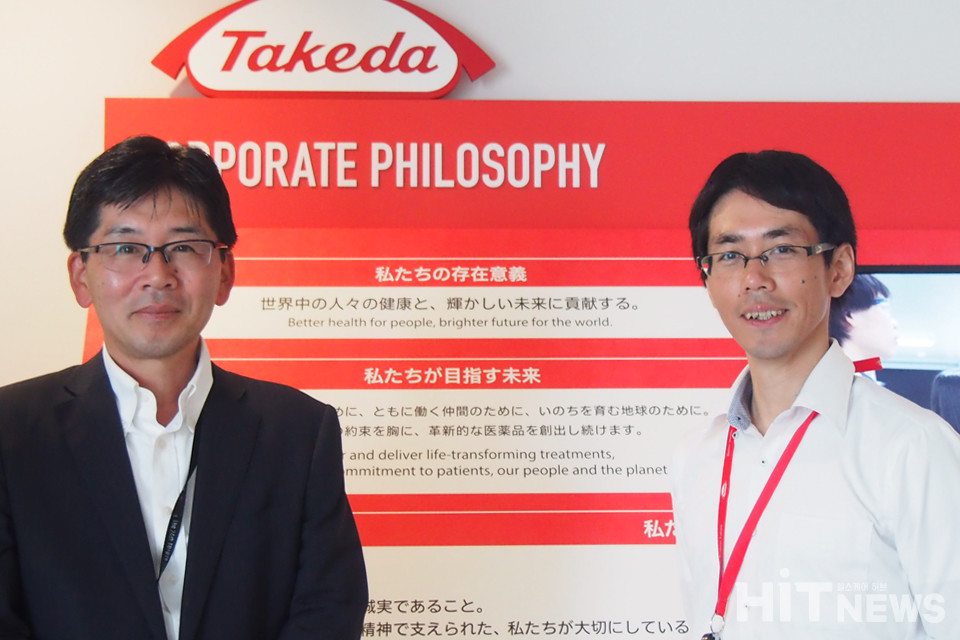
In August, HitNews met with Sato Masanori, Head of External Innovation Center (CEI), and Fujimura Ken, Lead, at Takeda Pharmaceuticals' Research and Development (R&D) department in Shonan Health Innovation Park, Kanagawa Prefecture, Japan.
What insights has Takeda Pharmaceuticals gained through external collaboration, pipeline establishment, and ecosystem building? In a two-part interview, we explore the criteria that guide Takeda Pharmaceuticals in pursuing open innovation partnerships, the global big pharma standards for open innovation they aspire to, and the attitude they adopt when facing these challenges.
①Fostering Innovation over Tomorrow's 'Returns' - Assisting Partner Commercialization
②Balancing Business and Research - Crossing Narrow Doors to Wider Opportunities
[Continuing from Part 1] In fact, in Korea, open innovation often comes with the saying, "Starting fast is possible, but escaping fast is difficult." There are cases where businesses continue to progress without considering their profitability. In this COCKPI-T project as well, we evaluated the profitability, but what do South Korean companies need when it comes to collaborating with global pharmaceutical companies?
Fujimura I think strategy can be simplified. One effective strategy for collaboration could be emphasizing how your technology or product stands out and can lead to innovative treatments for patients. Takeda values innovation, especially in first-in-class drugs or differentiation from other companies.
There's also a growing trend towards demanding novelty and innovation, which I believe applies to global companies as well. Demonstrating that your technology is backed by strong experimental data is important. Korean drug development ventures excel in this aspect.
Sato In fact, if we consider the COCKPI-T program, it serves as an initial stage for developing academic research topics before they become practical—a kind of technology incubation phase. While the initial ideas may be based on impressive science, there's often room for refinement. In these cases, we assess the technology and collaboratively work toward a common goal, combining input from the company and the applicants.
By guiding them like this, we aim to help them advance to the next stage, which is why we organize programs like COCKPI-T and “incubation”. Isn't partnering essentially about pooling our knowledge and collective wisdom? Yet, we also invest our company's talent and resources, so we actively seek topics and assets with evident synergy. When there's potential, we incubate them proactively to ensure they ultimately benefit patients through innovative medicines.
Ultimately, our goal is to understand the unmet needs of patients, align the entire value chain—including patients, doctors, and pharmaceutical companies—so that open innovation can come to fruition. When stakeholders from various perspectives come together and share their insights, the chances of success also increase, don't you think?
Considering all the stories you've shared, I'm led to think about what "fearless open innovation" truly means. In South Korea, there are times when investments are made while acknowledging the possibility of failure, sometimes even more than the likelihood of success. Conversely, it can be argued that embracing innovation without fear of failure is of paramount importance.
Sato Takeda actively participates in the topic selection process for the COCKPI-T program and demands the best from researchers. Of course, based on our cutting-edge expertise in pharmaceutical research and development (R&D), we will support and evaluate projects. Despite these best efforts, if there is no progress, it becomes challenging to sustain such projects in the long term.
Continuing such projects not only impacts Takeda but also the beneficiaries of the COCKPI-T program in the field of new drug development. Therefore, we apply strict criteria and work with applicants to design optimized research through thorough discussions.
That ultimately means, if there is an opportunity for support, the criteria to receive it is rigorously examined.
Sato It's essential, considering the risks. The criteria are strict, and Takeda is no different. After selection, the technology development process may face challenges. Researchers in the program should choose their topics thoughtfully, and both the company and researchers must propose a more suitable process, even if it's a small improvement.
In the COCKPI-T program, discussions with applicants persist from the initial screening all the way until researchers select their topics and draft contracts to commence collaborative research. This ongoing dialogue includes deliberations on possibilities, test plans, and mutual input. Once the contract is finalized, it paves the way for a seamless research plan execution.
Generally, government-led open innovation programs determine project viability based solely on the proposed research plan. In contrast, private-sector-led open innovation programs initiate the program after engaging in in-depth discussions about the research plan.
That means it's not just about accepting proposals with a quick "yes" or "no." While there might be initial interest in trying, failure is not taken lightly due to the potential time and resource investments. There is value in setting high standards and providing proper support to open innovation initiatives that meet those standards, allowing for effective plan execution. It can be seen as establishing a sense of "rightness" in this approach.
Sato For over 200 years, Takeda Pharmaceuticals, following the legacy of its founder, Chobei Takeda, has gone beyond a simple pharmaceutical business, placing a significant emphasis on the value of patients and people. I believe these aspects continue to promote Takeida's culture today.