

Big Pharma Faces Patent Expirations and Declining R&D Returns
Taehoom Jung Highlights Johnson & Johnson Innovation as a CVC Model

As global pharmaceutical companies increasingly invest in corporate venture capital (CVC) units, the industry is seeing a growing "symbiotic relationship" between big pharma and biotech startups. This sentiment was a key theme at the "Innovation-Driven Nation: Korea International Symposium 2024," hosted by Seoul National University, KAIST, and the JoongAng Ilbo. Taehoom Jung, CEO of Adelphi Ventures, explained why big pharma depends on startups for survival.
Adelphi Ventures, a venture capital firm that supports Korean biotech companies entering the U.S. market, has invested in companies with cutting-edge technologies in drug development. According to Jung, "Big pharma operates in a highly volatile industry. Of the top 15 companies in 1974, only six remain today. The industry faces a looming patent expiration crisis, with Merck’s Keytruda patent expiring in 2028 and several others set to expire by 2027-2028."
Jung further illustrated the challenges, noting that in 2013, big pharma’s return on investment (ROI) in R&D was 6.5%, dropping to just 0.6% by 2022. "Internal R&D is yielding fewer results, as seen between 2015 and 2021, when companies like Johnson & Johnson, Astellas, and Sanofi failed to develop a single new drug internally."
The solution, Jung emphasized, lies in fostering a symbiotic relationship between big pharma and startups. He explained, "Big pharma invests in startups at the seed stage, signs licensing agreements for asset-related technology, and often acquires startups at the exit stage." He pointed out that while the number of companies with active pipelines has surged—from 1,200 in 2001 to over 6,000 by 2024—big pharma’s share of these pipelines has decreased, with startups gaining a growing presence. "Between 2015 and 2021, 65% of the 138 drugs approved by the U.S. FDA were based on externally sourced pipelines."
Jung highlighted the crucial role of CVCs in this ecosystem. "Johnson & Johnson Innovation is a prime example, covering areas such as early-stage partnerships, venture investments, incubation, and late-stage collaborations." He also noted the recent opening of JLABS Korea, a branch of Johnson & Johnson’s global accelerator platform, designed to help South Korean biohealth companies expand internationally and increase competitiveness.
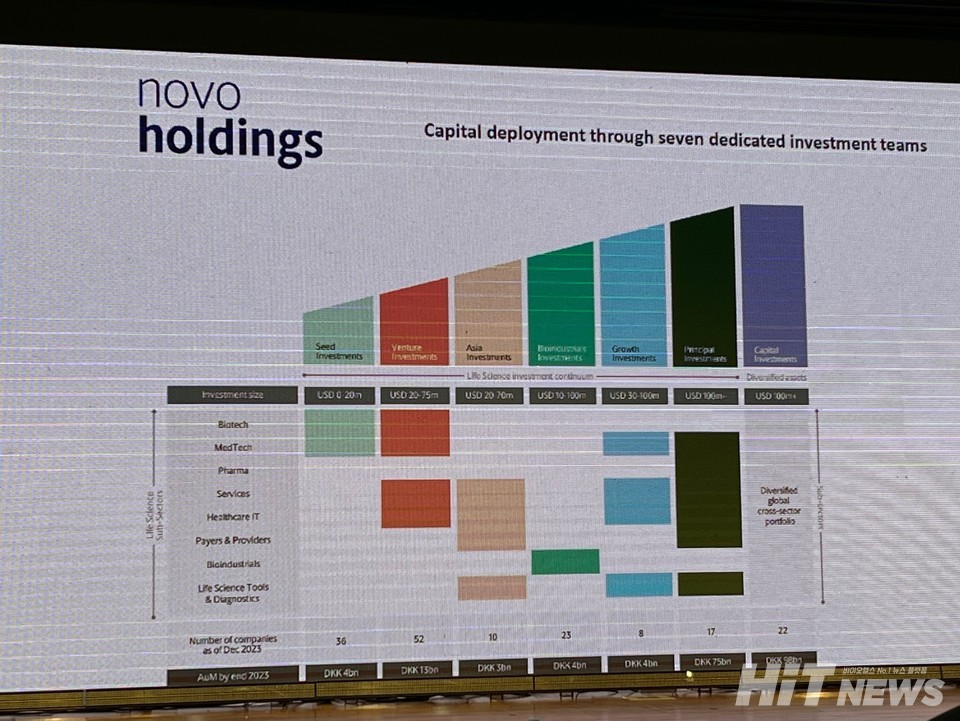
Jung provided further examples of successful investments, noting that Pfizer has invested $1.6 billion in biotech companies, while Novo Holdings boasts a 9.4% return rate on investments. "Novo Holdings operates seven investment teams, covering seed investment, venture capital, and Asian investments."
He concluded by showcasing a successful collaboration between Japan’s Astellas and Boston-based VC MPM Capital, which launched DigiTx Partners, a digital healthcare investment fund, in 2016. Jung urged large companies to seek venture capital firms that align with their strategic goals to achieve impactful results.