

Panolos Bioscience, RayMed, and Txinno Bioscience Shine in Season 3's Biotech Innovation Showcase
STAR in TECH Bio has returned. Striding confidently into the parched heart of the bio-investment landscape, it brings water to the arid soil and plants seeds for the future. Those drawing water alongside it are the 'mentors' and 'seniors' who have overcome the challenges of their seedling days to bloom. United in the belief that 'people are everything,' The Companies, DLG, and the Korea Biotechnology Industry Organization have taken up the pen to connect people. At the tip of this pen are Panolos Bioscience, RayMed, and Txinno Bioscience. Here, we introduce the top three companies of STAR in TECH Bio Season 3.
For biotech companies in drug development, platform technology is crucial. It provides a steady revenue model. Panolos Bioscience (CEO Hyeseong Lim) has a unique platform called 'Alpha-ART (α-ART, Alpha Anti-angiogenesis-based Artifact Re-targeting Tri-specific),' which stands out in the market and fosters collaborations with other biotech firms. This innovation caught the eye of Byung-gun Lee, chairman of GI Innovation and mentor for STAR in TECH Bio Season III.
Last May, GI and Panolos signed a joint research memorandum of understanding (MOU). Their mentor-mentee relationship through STAR in TECH seemed almost destined. To explore the roots of this partnership, <Hit News> delved deeper into their story.
Panolos and GI have formed a mentorship through this season of STAR in TECH. It’s interesting that you first created a business partnership and then established a mentorship. What are the main points of this collaboration?
"The core of our collaboration is the Alpha-ART platform. It can be seen as the framework for creating tri-specific fusion proteins. Panolos provides the framework, and GI adds the target molecules, effectively fleshing it out."
To put it more simply, can we think of tri-specific fusion proteins as similar to tri-specific antibodies?
"They might seem similar, but it’s hard to call Alpha-ART an antibody. We take the necessary parts from antibodies and combine them with other proteins, which is why we refer to it as a fusion protein."
What do you mean by "taking the necessary parts and combining them?
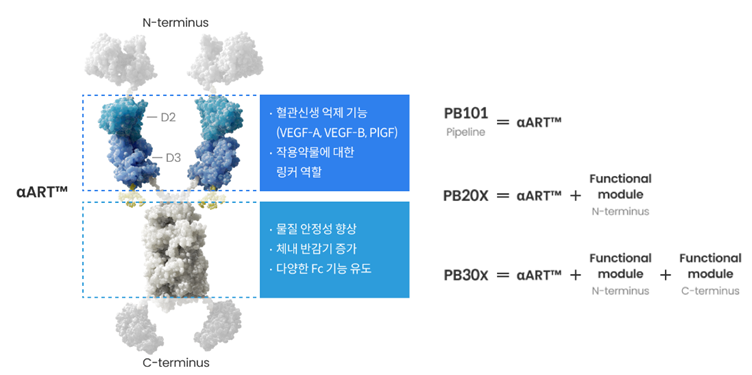
"In a typical antibody, there is a component called the Fc region, which is responsible for stability. We take the Fc region and combine it with VEGF receptor 1 (VEGFR1), creating the current Alpha-ART platform. This form is also our leading pipeline, 'PB101.'
When this fusion protein, which combines VEGF receptor 1 and the antibody Fc region, enters the body, the VEGF receptor 1 part binds to substances like VEGF-A, VEGF-B, and PlGF. This prevents these substances from acting on cancer cells, thereby inhibiting the cancer cells from attracting new blood vessels and hardening. The Fc region helps this fusion protein circulate in the body for a longer period."
I understand that Alpha-ART is a tri-specific platform and targets VEGF-A/VEGF-B/PlGF on its own. If we call this Target 1, it seems the platform can be modified to add Target 2 and Target 3.
"That's correct. For example, we can attach an immuno-oncology drug to the Alpha-ART platform. The Alpha-ART platform targets the cancer and removes harmful substances around it, while the immuno-oncology drug attached to the platform enhances the ability of immune cells to kill cancer cells. This concept forms the basis of the collaboration between GI and Panolos."
To summarize, GI develops the immuno-oncology drug, which corresponds to Target 2, and provides it to Panolos. Panolos then attaches this immuno-oncology drug to the Alpha-ART platform. This results in the creation of a bi-specific fusion protein drug.
"That's right. Our first task with GI will be to create a bi-specific fusion protein. If the research on this compound shows good results, we can consider adding Target 3 to develop a tri-specific fusion protein."
I assume the advantages of the Alpha-ART platform go beyond just the possibility of bi-specific and tri-specific targeting, especially since concepts like bi-specific and tri-specific antibodies already exist in the market.
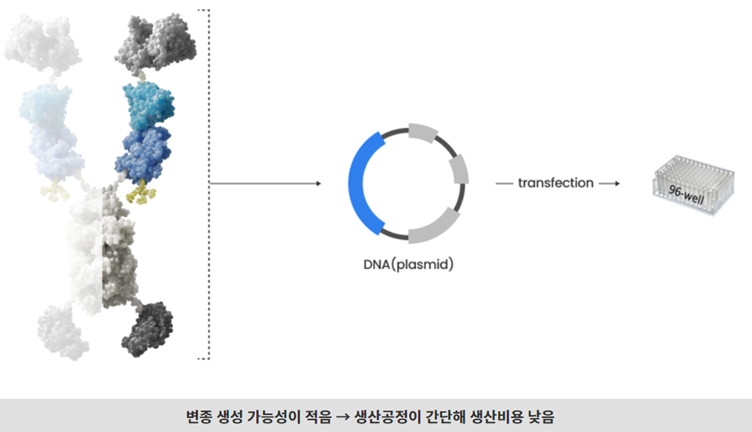
"One of the key competitive strengths of Alpha-ART is its cost-effectiveness, which comes from the simplicity of its production process. The production processes for bi-specific and tri-specific antibodies being developed by global biotech companies are quite complex.
Let me give an example with the traditional process for bi-specific antibodies. The left and right parts of the antibody need to be different, so each part has to be produced in two separate cell lines. This makes the development cost twice as high compared to a process that uses only one cell line. Additionally, the probability of getting the desired combination from these two cell lines is theoretically only 33%. This means two-thirds of the produced antibodies need to be discarded, resulting in low productivity.
However, Alpha-ART is made by inserting a single plasmid into one cell line. Even with this simpler process, it can achieve tri-specific targeting. This lowers the production complexity and reduces costs significantly."
From the perspective of Panolos or any future partner companies, this is beneficial. Producing drugs at a lower cost can help increase corporate profits and allow for lower pricing, which is good for patients as well.
"Exactly. Pharmaceutical companies prefer to produce drugs as cheaply as possible. For example, CAR-T therapy can cost thousands of dollars per treatment. While CAR-T is an excellent treatment, its high cost is a burden on government insurance budgets and patients' personal finances. If the same treatment can be provided at a lower cost, it benefits the company, the state, and the patients."
Now let's discuss Panolos's overall strategy. What are the key directions you are pursuing in pipeline development?
"There are two main directions. First, we reduce development risks by focusing on the fusion of best-in-class drugs. Developing entirely new modalities or first-in-class drugs is very challenging. While they may have higher future value, proving the concept is difficult and requires significant time and resources, making it an unsuitable strategy for us. Instead, we aim to reduce risk and increase synergy by integrating drugs with well-verified safety and efficacy in the real world into our platform.
Second, many immune checkpoint inhibitors, aside from PD-1/L1 inhibitors, have recently failed in clinical trials. We believe that our Alpha-ART platform can help overcome these failures. Since VEGF and PlGF targeted by Alpha-ART have functions that regulate immune cells, they can modify the tumor microenvironment (TME) to be more conducive to anti-cancer activity. This approach allows us to create collaboration opportunities with biotech companies developing new immune checkpoint inhibitors."
Lastly, I'm curious about Panolos's hedging strategy in a sluggish bio-investment market. Do you have any plans to navigate this period when it's difficult to secure sufficient development funds?
"Securing ample investment to carry us through to Phase 2 clinical trials is currently unrealistic. However, just because it's difficult doesn't mean it’s impossible or something we should give up on. We need to strategize towards minimizing development costs.
The key to this is collaborative R&D through the Alpha-ART platform. This approach allows both parties to share the development costs and risks. For instance, we are already conducting a joint development project to integrate Kelun-Biotech's immuno-oncology drug with our platform. This pipeline, 'PB203,' is a bi-specific fusion protein aimed at treating pancreatic cancer. We are responsible for the clinical trials, which reduces the development risk for Kelun. Additionally, we received the rights to the immuno-oncology drug sequence from Kelun at no cost, significantly cutting down the costs for Panolos in creating a new pipeline.
We plan to continue forming such deals. Both Kelun and GI Innovation are companies with global development experience. By leveraging their capabilities, we can share development know-how and continuously create opportunities for candidate substance discovery and licensing."
"Many South Korean biotech companies tend to think of global companies as the only possible partners for joint development. However, I believe that we can find sufficiently sharp collaboration points within Korea as well. Panolos's platform technology has competitive strength that can succeed in the global market.
The most important aspect of such collaborations is to ensure 'a long-term relationship of trust.' No matter how advanced the technology is, drug development can fail. But even if it fails, if the partner is genuinely committed and passionate about drug development, they will succeed eventually. The ideal partner is a team that is entirely focused on drug development without distractions or ulterior motives. I believe that Panolos's CEO, Hyeseong Lim, is such a person.
I anticipate that Panolos's unique platform technology will create synergy with our efforts. In this sense, collaboration will be highly competitive. We will provide direct support from project selection to development to ensure that the joint projects meet global standards."
"The Alpha-ART platform excels in normalizing blood vessels and improving the tumor microenvironment (TME) by binding VEGF-A, VEGF-B, and PlGF to the VEGF receptor 1 located at the N-terminus. It also has the advantage of being able to introduce additional target substances at the N- and C-termini, allowing for the high-yield production of multi-target fusion proteins within a single plasmid.
Currently, our leading pipeline, PB101, is undergoing Phase 1 clinical trials in Korea. Additionally, we are developing bi-specific (PB203) and tri-specific (PB301) candidate substances. The Alpha-ART platform enables active collaboration with companies that have new targets, and its excellent internalization function makes it a promising platform for developing bi-specific antibody-drug conjugates (ADCs)."
관련기사
- 삼중항체? 아니, 삼중표적 융합단백질…'혜성'처럼 날아온 파노로스
- 멘토십 넘어 파트너십… '스타인테크 바이오 시즌3' 톱3 공개
- '스타인테크 바이오 시즌3' 시작…신약 멘토와 손잡을 TOP5는?
- 레이메드의 방사성약 사용법 '핵'꿀팁… 몬테카를로가 뭔데?
- RayMed Pioneers Precision: The Future of Radioligand Therapy
- 티씨노-리가켐, 두 '선후배'의 만남… "ULK1i First in Class 향해 질주"
- Txinno and LigaChem: Racing Towards ULK1 First in Class
- 스타인테크 시즌3... 심사위원들이 'PICK'한 차세대 벤처, 어디?
- STAR in TECH Season 3: Judges’ Top Picks