

Reimbursable AI diagnostics fuel profitability as the company accelerates overseas strategy
Seers Technology expects to sustain strong revenue growth by expanding adoption of its AI-based diagnostic and monitoring platforms while accelerating its push into the Middle East and North Africa (MENA) region.
On Feb. 4, the company held an investor relations briefing for institutional investors and analysts, outlining its recent performance and medium- to long-term growth strategy.
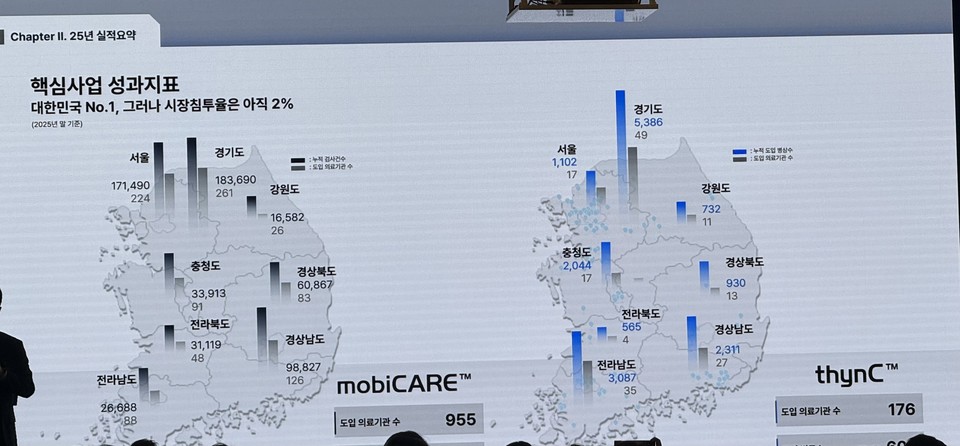
Seers’ flagship products include mobiCARE, an AI-powered diagnostic and predictive platform, and thynC, an inpatient and post-discharge monitoring solution. mobiCARE is a wearable electrocardiogram (ECG) device that continuously records ECG data for 24 hours or longer and uses AI to detect arrhythmias. thynC analyzes multiple vital signs from hospitalized and recently discharged patients to predict abnormalities and issue real-time alerts.
The company’s revenue-generating pipeline is built around four segments: mobiCARE for hospitals, mobiCARE for health screening centers, inpatient monitoring, and post-discharge monitoring. To date, mobiCARE and thynC have been adopted by 955 and 176 medical institutions in Korea, respectively.
CEO Young-shin Lee said the company has proven clinical equivalence with existing solutions while offering a differentiated business model. “Unlike high-priced legacy systems, our platforms generate revenue through reimbursable medical fees, allowing hospitals to adopt them without additional capital investment,” he said.
Seers reported revenue of $33.0 million last year, up 595% from $5.55 million a year earlier. Operating profit also swung from a $5.96 million loss to an $11.2 million profit, marking a return to profitability.
Growth was driven primarily by thynC, whose revenue surged 1,031% year on year. By integrating ECG, respiration, oxygen saturation, heart rate, and body temperature into a single interface through its thynC Alliance function, the platform reduced costs and improved clinical efficiency, including time-based medication administration records.

Lee noted that primary and secondary hospitals in Korea are increasingly positioning inpatient monitoring systems as a core strategic asset. “With further technological refinement and clinical validation, we plan to strengthen partnerships with hospitals and expand our product portfolio,” he said.
The company expects momentum to continue. As of last year, approximately 11,014 thynC units had been installed, with a target of 54,000 units by this year. Adoption of mobiCARE is also expected to rise as its use expands into outpatient diagnostics at large health screening centers.
To support long-term growth, Seers is pursuing broader multi-ward deployments and building a smart-ward ecosystem through closer collaboration with biosensor partners. From 2028, overlapping contract renewals and new demand are expected to accelerate, significantly boosting profitability.
Overseas expansion remains a key pillar of the strategy. Seers aims to raise market penetration in the MENA region to 5–7%. The company has targeted the Middle East since 2018, citing strong fundamentals: the region has roughly three times more hypertension patients than Korea, with reimbursement levels about four times higher.
“The Middle East is a critical business hub,” Lee said, adding that the company is also positioning the United States as another strategic base. “We plan to launch new services in the U.S. this year and expand our global footprint through entry into the UAE and the U.S.”