

From Korea’s Brain Research Legacy to a New Therapeutic Bridge for Social Interaction
South Korea marks the 27th year since the enactment of the Brain Research Promotion Act in 1998. While the nation’s basic neuroscience capabilities have advanced rapidly, the translation of that research into truly innovative, patient-accessible drugs remains limited. Central nervous system (CNS) disorders—particularly autism spectrum disorder (ASD)—remain among the most difficult frontiers in drug development, even for global pharmaceutical companies, due to high costs and low success rates.
Hit News met with co-CEOs Chan-young Shin and Dong-cheol Seo at NeuroVenti’s headquarters in Gangnam, Seoul, to discuss the current landscape of autism drug development and the company’s core mission of “connecting people and society.” Beyond their confidence in a multi-target therapeutic strategy, the discussion revealed a deep empathy for patients and families navigating isolation and unmet medical needs.
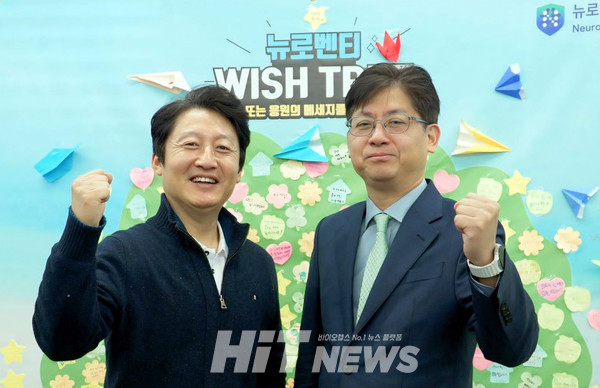
Autism Patients in Isolation
Why autism, among so many intractable brain disorders? Shin pointed to a stark contrast between Korea and the United States.
“In the U.S., when you ask which two conditions matter most in brain science, the answer is almost always Alzheimer’s disease and autism,” he said. “Alzheimer’s threatens quality of life in old age, while autism is a lifelong developmental disorder.”
In the U.S., autism research funding reaches roughly 30–40% of that allocated to Alzheimer’s disease. In Korea, however, Shin observed a different reality.
“There is still a strong tendency to hide developmental and mental disorders,” he said. “It’s not that there are fewer patients—they are socially isolated and remain out of sight. Closing this perception gap is as important as the science itself.”
After more than 20 years in neuroscience, Shin said founding NeuroVenti was a way to step directly into patients’ lives. Current treatments, he noted, largely manage associated symptoms such as aggression or ADHD, while failing to address autism’s core challenge: impaired social interaction.
“At the heart of autism treatment is the ability to make eye contact and communicate,” he said. “Our goal is to build a therapeutic bridge that reconnects isolated patients with the world.”
A “Master Key” Found to Social Interaction
Autism drug development is uniquely difficult because brain function depends on highly complex, multilayered systems. Shin attributed many past failures to single-target approaches.
“The brain is not like the heart or liver,” he explained. “It is an intricate network of neural circuits and receptors. Modulating just one target rarely produces meaningful effects.”
NeuroVenti’s lead candidate, NV01-A02, takes a different approach: a single-molecule, multi-target strategy that precisely modulates several receptors involved in social behavior, including dopamine and serotonin, at the same time.
Often likened to opening multiple locks with one “master key,” the approach is the result of six years of big-data and multi-omics analysis integrating animal and human datasets. NeuroVenti identified NV01-A02 as a compound that improves social interaction—the core deficit in autism—while minimizing common CNS side effects such as drowsiness, weight gain, and motor impairment.
A Phase 2 clinical trial is currently underway at eight university hospitals in Korea, with approximately 70% of dosing completed. No major drug-related adverse events have been reported to date. If statistically significant improvements in social function are confirmed, Shin said, NV01-A02 could redefine the global paradigm for autism treatment.
A CDRO Model for Rigorous CNS Validation
NeuroVenti’s second growth pillar is its CDRO (CNS-focused drug research organization) model, which provides specialized capabilities across early drug development—from efficacy and mechanism-of-action studies to safety and side-effect evaluation.
“CNS drug development is far more demanding than oncology,” Shin said. “You must rigorously assess risks such as insomnia, seizures, and even dependence or abuse.”
For most startups, maintaining the required infrastructure and expertise is unrealistic. By sharing its CNS research platform, NeuroVenti aims to improve overall success rates across the industry.
The company is also expanding collaborations with AI-driven drug discovery firms. “AI can generate tens of thousands of candidate molecules,” Shin said, “but proving how those compounds actually function in the brain still requires experimental validation. By verifying AI-predicted candidates, we believe we can meaningfully raise the probability of success.”
Building a Bridge Back to the World
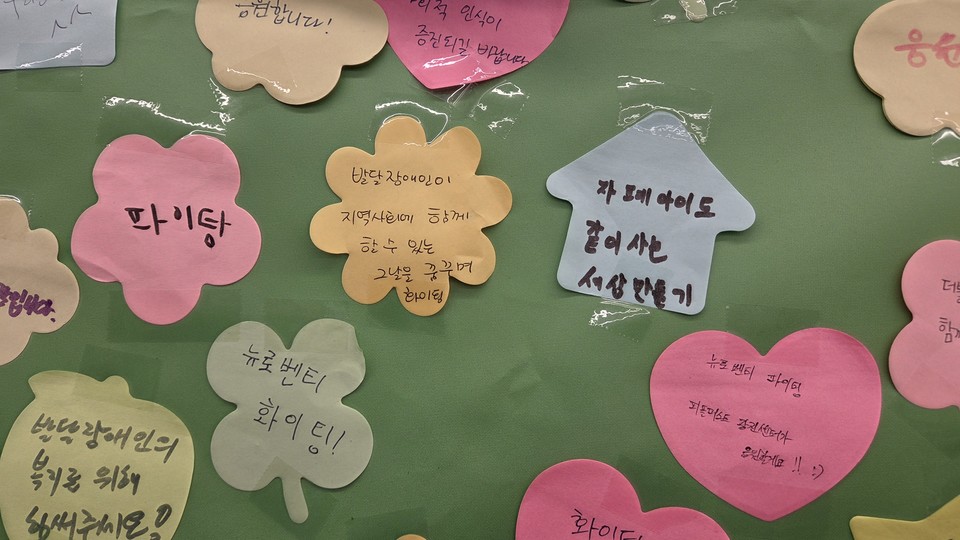
At the entrance to NeuroVenti’s office, handwritten notes from patients and families—collected at the Autism Expo—cover the walls. The co-CEOs say these messages are the first thing employees see each morning.
“They remind us that developing medicine is ultimately about reconnecting people with society,” they said.
“For parents of children with autism, the deepest wish is simple—to make eye contact and share an ordinary conversation,” the co-CEOs added. “We hope the medicine we are developing can help turn that long-held hope into reality.”