

Reforms include accelerated listing for rare-disease therapies, strengthened essential-drug safeguards, and a reset of the generic pricing framework.
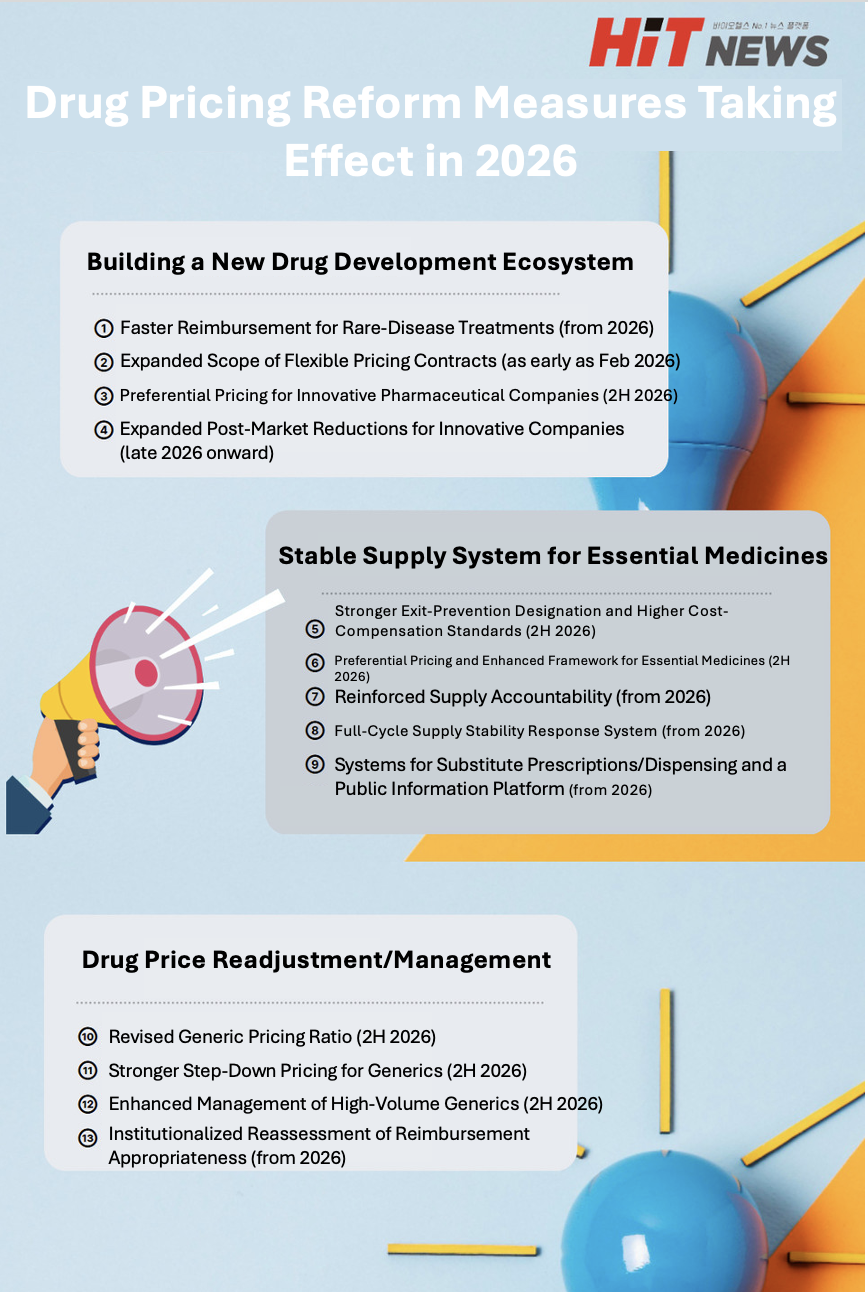
The government will launch a comprehensive restructuring of the national drug pricing system next year, with major changes to take effect in 2026. The reform centers on enhancing value-based pricing for new medicines and reinforcing the supply stability of essential drugs.
Key measures include a significant reduction in the listing timeline for rare-disease treatments and lowering the generic pricing ratio from 53.55% to the 40% range. Supply-stability mechanisms—such as higher cost-compensation standards and expanded price add-ons—will be strengthened for exit-prevention medicines and national essential drugs. Hit News reviewed the policies scheduled for implementation in 2026.
Beginning next year, the Ministry of Health and Welfare will streamline reimbursement reviews and price negotiations for rare-disease therapies, cutting the maximum evaluation period from 240 days to under 100 days. A National Health Insurance pilot will start in early 2026, after which the system will be formalized through regulatory revision. Listed products will undergo post-evaluation based on clinical performance, with reimbursement scope adjusted as needed.
A flexible pricing contract model will also be introduced. Starting in Q2 2026, the refund-based pricing scheme will extend to newly listed products, patent-expired originals, items exiting risk-sharing agreements, and biosimilars. Prices will be determined through a separate contract with the National Health Insurance Service (NHIS), within the A8-adjusted ceiling. Patient cost-sharing rules will be revised to prevent unintended refund burdens.
Policy incentives for innovative pharmaceutical companies will expand. From late 2026, designated innovative firms will receive preferential add-ons in price assessments, and companies with strong R&D activity may qualify for price-increase incentives even without formal designation. In post-market monitoring, these firms will receive larger reductions under the volume–price linkage system.
Supply-stability reforms for essential drugs will also advance. In late 2026, the designation criteria for exit-prevention drugs will increase by 10%, with broader use of administrative designation. The cost-compensation threshold will rise from $68,000 to $340,000, and price-setting procedures will be revised to more promptly reflect raw-material cost increases. Manufacturing-cost calculations will expand to include machinery operating time and facility investment, and policy add-ons of up to 7% may be granted. Incentives for adherence to supply contracts will be reinforced.
For national essential medicines, price add-ons will expand for products that contribute to stable supply, including those using Korean-made raw materials. Already-listed essential drugs using domestic ingredients will also be eligible. Products receiving price increases for supply stabilization will be exempt for a period from volume–price linkage cuts, and drugs requiring national supply management will be excluded from price-reduction targets. Companies receiving these incentives must sign enhanced supply-obligation contracts.
A full redesign of the drug supply-stability response system will begin in 2026. Under the revised Pharmaceutical Affairs Act, a new public–private Supply Stability Council will monitor production and distribution in real time and initiate targeted response measures when risks arise. To minimize confusion during shortages, prescribing systems will guide clinicians to equivalent substitutes, and pharmacists will be able to share substitution records with physicians via a public platform.
A core component of the reform is restructuring the generic pricing system. From July 2026, prices for generics and patent-expired originals will be reduced to the 40% range, aligning with major international markets. Generics that fail to meet baseline requirements will be priced at 80% of that level. Older products that have maintained original prices since the 2012 reform will be reassessed and gradually adjusted downward.
Generic step-down pricing will also be reinforced. Beginning with the 11th product of the same formulation, prices will decrease by 5 percentage points from the first generic; for innovative companies, the reduction will be 3 points. If 10 or more generics are listed simultaneously with the first entrant, all will be re-priced to the 11th-product level one year after listing.
Starting in 2026, Korea will also launch a full re-evaluation of reimbursement appropriateness for substances requiring reassessment of clinical usefulness. Priority will go to drugs undergoing re-evaluation in A8 countries, those with new evidence contradicting existing efficacy claims, and products flagged by expert groups. Depending on the findings, measures such as delisting or selective reimbursement will be applied through a simplified process.