

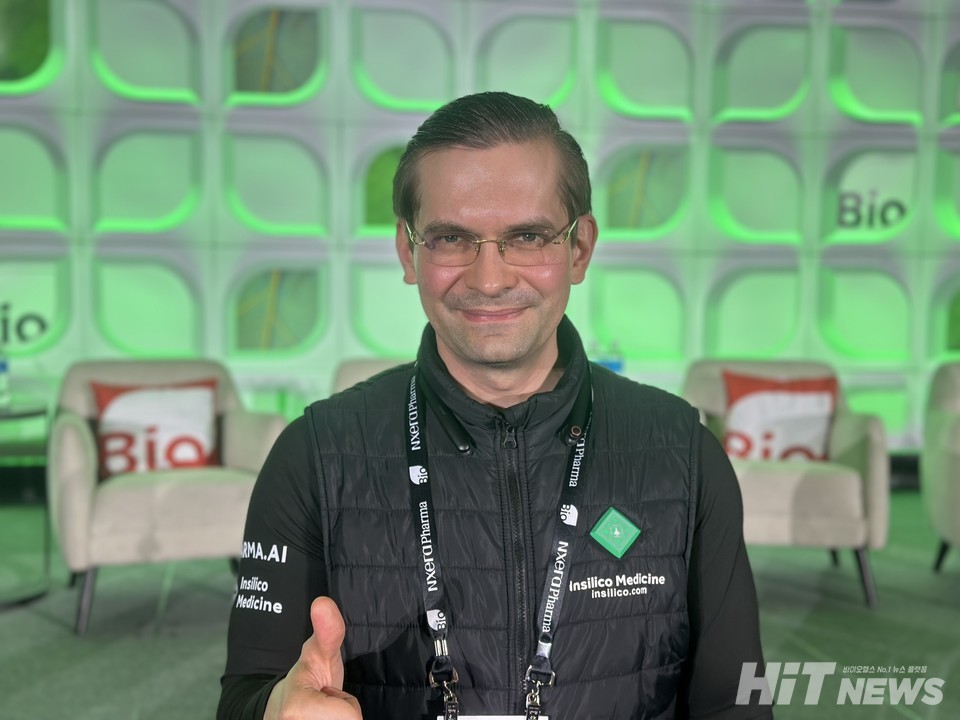
Interview with Alex Zhavoronkov, Founder & CEO of Insilico Medicine

“We’ve now reached a stage where the value of AI-driven drug development is no longer proven through papers or technical descriptions, but through clinical data from real patients. The recently announced Phase 2a results of Rentosertib are clear evidence of this.”
AI Research Shows Clinical Impact
At BIO USA 2025, Insilico Medicine, a pioneer in AI-driven drug discovery, spotlighted clinical achievements over technology showcases. CEO Alex Zhavoronkov declared, “We’ve created the first case in which an AI-discovered target and an AI-designed molecule demonstrated efficacy in humans.”
The highlight was Rentosertib, an oral TNIK inhibitor for idiopathic pulmonary fibrosis (IPF), identified and designed by Insilico’s proprietary AI platform. In a Phase 2a trial published in Nature Medicine, patients demonstrated dose-dependent improvement in lung function within 12 weeks, including notable gains in forced vital capacity (FVC).
Zhavoronkov described the results as “remarkable,” emphasizing the difficulty of evaluating clinical efficacy in advanced IPF due to limited pulmonary testing. To address this, Insilico is also pursuing biomarker research to refine outcome measurements.
In parallel, Insilico has published a series of papers in Nature Biotechnology and collaborated with the University of Toronto on a KRAS inhibitor designed using a quantum-classical hybrid model.

Another lead candidate, ISM5411, a PHD1/2 inhibitor for inflammatory bowel disease (IBD), completed Phase 1 trials in China and New Zealand. It showed strong safety due to local targeting and minimal systemic exposure. “This could offer a much-needed alternative for patients with limited options,” said Zhavoronkov.
Three oncology programs have also entered first-in-human dosing, with interim results expected soon. Meanwhile, a long-acting oral GLP-1 analog and a novel non-opioid analgesic—both AI-designed—are advancing through preclinical studies. The GLP-1 analog aims for weekly oral dosing, and the analgesic candidate has shown potent, non-addictive pain relief in mouse models.
Investors Now Back Clinical Outcomes Over AI Hype

Insilico recently closed a $123 million Series E round, pushing total funding beyond $500 million. Zhavoronkov noted a clear shift in investor sentiment: “Two years ago, it was all about the AI. Now, the question is: does it deliver in the clinic?”
The company’s global strategy includes BD operations in Boston, AI research in Montreal, and a discovery team in Shanghai for rapid compound validation. In one standout case, Insilico helped Korean biotech Therasid identify a viable lead within four months—after years of failed efforts using traditional CROs.
Insilico is also deepening AI collaborations with major Korean pharmaceutical companies and expanding its platform into materials science, agriculture, nutrition, and aging-related diseases. In Shanghai, the company has built a fully automated lab to test and refine AI-generated hypotheses in a closed-loop cycle.
Zhavoronkov, who envisions aging as a treatable disease, hinted at potential senolytic effects of TNIK inhibitors. He concluded: “AI must be validated in the real world—not in theory. The only proof that matters is helping patients. And that’s already happening.”