

Vaccine-driven sales plummet for others while AZ leads on oncology and strategic realignment

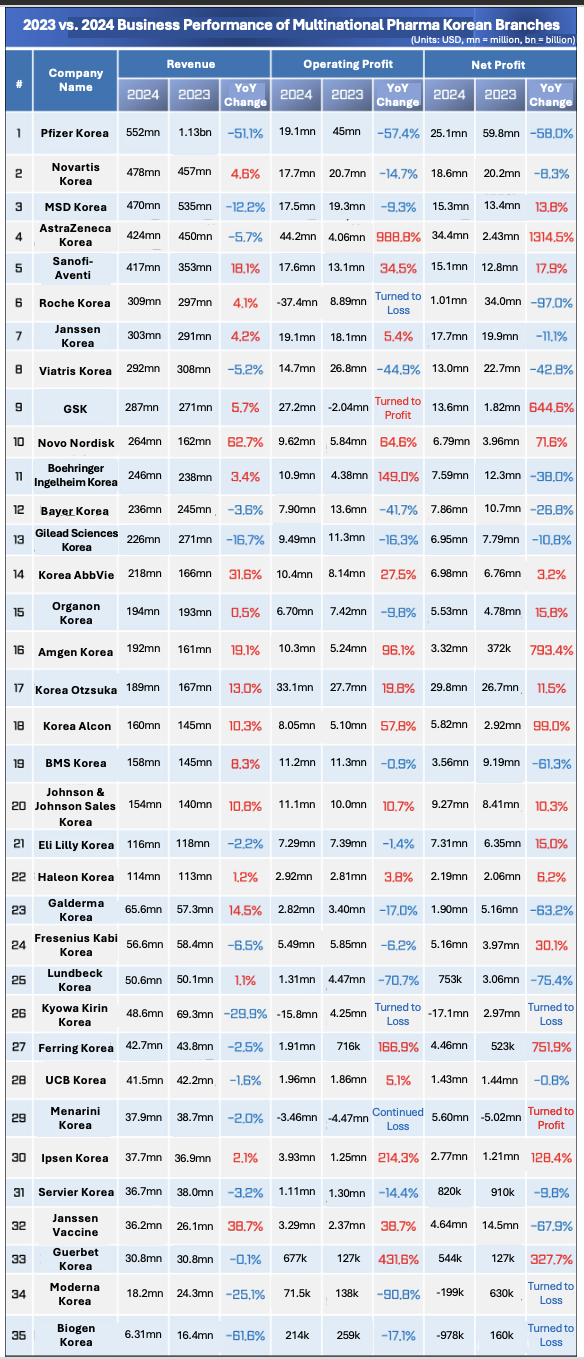
In the post-COVID landscape, South Korean branches of multinational pharmaceutical companies experienced notable revenue declines—particularly those that previously benefited from vaccine sales. Yet amid the downturn, AstraZeneca Korea posted record earnings, topping peers in both operating and net income.
According to Hit News' analysis of financial audit reports filed with the Financial Supervisory Service by April 15, key vaccine suppliers—Pfizer Korea, MSD Korea, AstraZeneca Korea, and Moderna Korea—recorded significant year-over-year revenue drops in 2023.
Pfizer maintained its top-line position with $1.13 billion in sales. However, revenue dropped 51.1% year-over-year to $552 million. Operating and net profits also declined by 57.4% and 58.0%, respectively. As the first to launch a COVID-19 vaccine in Korea, Pfizer's initial dominance gave way to flat growth in its broader portfolio.
MSD Korea saw its revenue fall 12.2%, from $536 million to $470 million. Still, growth in its oncology drug Keytruda (pembrolizumab) and the inclusion of Vaxneuvance—its 15-valent pneumococcal conjugate vaccine—in the National Immunization Program helped offset losses. Operating profit declined 9.3%, while net profit rose 13.8%.
In contrast, AstraZeneca Korea limited its revenue decline to just 5.7%, largely due to its early exit from the vaccine market. Operating profit soared 988.8% to $44.1 million, while net profit jumped 1314.5% to $34.4 million—the highest growth among its peers.
Despite pulling Farxiga (dapagliflozin) from the market in Q2 2023, AstraZeneca continued sales of its combination products—Xigduo, Qtern, and Sidapvia. While Farxiga’s removal was expected to reduce earnings, strong uptake of Tagrisso (osimertinib) more than compensated. Approved in January 2023 for first-line treatment of EGFR-mutated non-small cell lung cancer, Tagrisso’s outpatient prescriptions surged 53.4% to $93.8 million, according to Ubist.
Novo Nordisk Korea also reported strong gains, driven by the launch of Wegovy (semaglutide), a once-weekly GLP-1 receptor agonist for obesity. Using its existing Saxenda sales network, the company rapidly penetrated the market despite temporary shortages fueled by social media demand.
Amgen Korea followed with robust performance, generating $123 million in sales for its osteoporosis treatment Prolia (denosumab), representing over 60% of its total $190 million revenue, per IQVIA.
However, Prolia’s dominance may wane. With the April 1 reimbursement listing of Celltrion’s biosimilars—Stoboclo and Osenvelt—a mandated price cut reduced Prolia’s ceiling price to 80% of its original.
In contrast, some companies struggled. Kyowa Kirin Korea offloaded its hematology and nephrology portfolio to DKSH Korea in late 2023 and downsized operations, retaining only its rare disease unit. The company implemented an early retirement program for the remainder of its workforce.
Looking ahead, ongoing uncertainties—such as Korea’s healthcare worker strike and looming international price reviews—are expected to influence how global pharma companies recalibrate their Asia-Pacific strategies, particularly within the Korean market.